What is the circle of fifths?
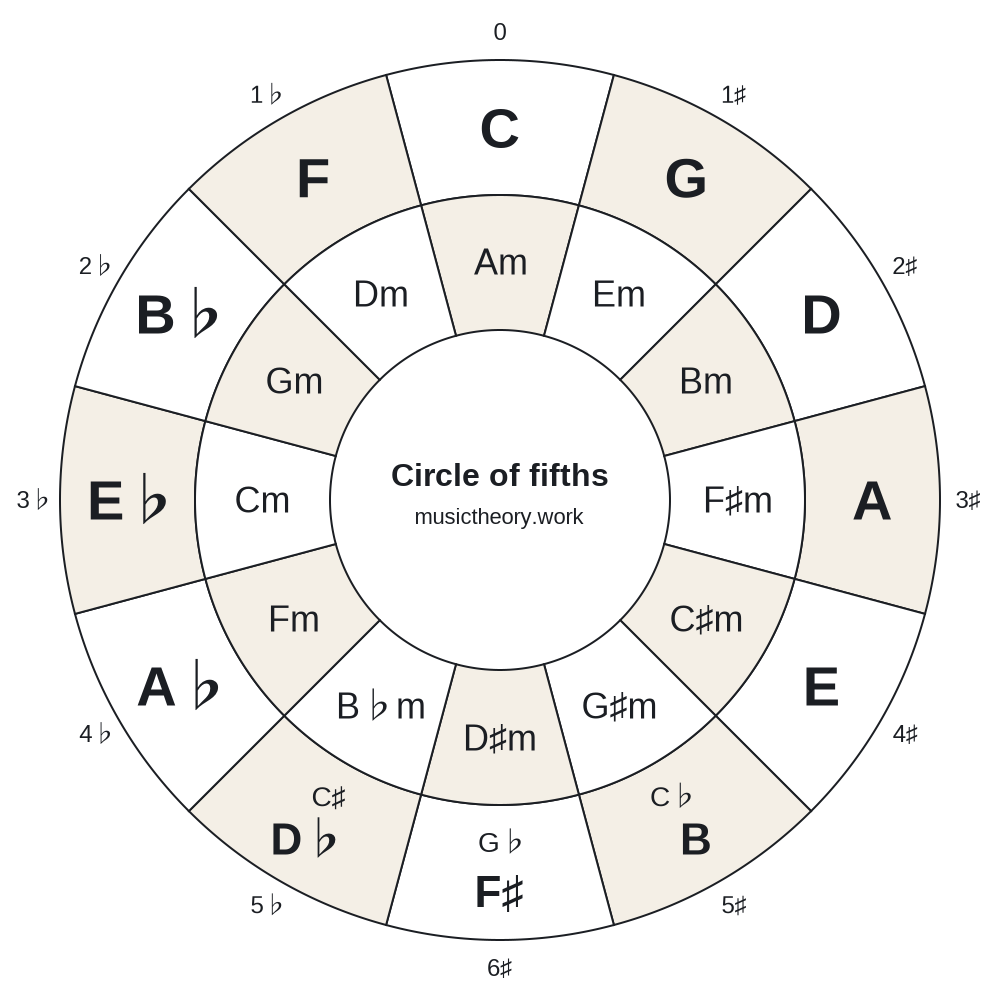
The circle of fifths is a diagram of the 12 major keys and their relative minor keys. Each step clockwise moves up a perfect fifth, and each neighboring key differs by just one note.
That single arrangement answers most everyday key questions: how many sharps or flats a key has, which minor key shares its signature, which chords belong together, and which keys are easiest to move to.
How to read the circle of fifths
C major sits at the top, with no sharps or flats. From there, the direction you move tells you what changes.
- Clockwise, each key is a perfect fifth higher and adds one sharp: C, G, D, A, E, B, F♯.
- Counterclockwise, each key is a perfect fifth lower and adds one flat: C, F, B♭, E♭, A♭, D♭, G♭.
- The outer ring shows major keys. The inner ring shows the relative minor that shares each key signature.
- At the bottom the two directions meet. F♯ and G♭ sound the same but are spelled differently; these are enharmonic keys.
The order of sharps and flats
Sharps always enter a key signature in the same order: F, C, G, D, A, E, B. Remember it as “Father Charles Goes Down And Ends Battle.” Flats use the same letters in reverse: B, E, A, D, G, C, F.
Two shortcuts name a key from its signature. With sharps, go up a half step from the last sharp: a last sharp of C♯ means D major. With flats, the second-to-last flat is the key: flats of B♭, E♭, and A♭ mean E♭ major. One flat alone is F major.
Find the chords in any key
The chords of a major key are clustered together on the circle. Pick your key, then look one step to each side: those three major chords are I, IV, and V. In C major, they are C, F, and G.
The three minor chords sit directly inside them. Dm, Am, and Em are ii, vi, and iii in C major. Only the diminished chord, B° (vii°), falls outside this cluster.
Why chord progressions follow the circle
Moving counterclockwise lowers the root by a fifth, the strongest root motion in tonal harmony. V to I is one such step, which is why it sounds so final.
Chain those steps and you get some of the most common progressions in music. The jazz ii–V–I in C is Dm, G, C. Extend it backward for iii–vi–ii–V–I: Em, Am, Dm, G, C.
Changing keys with the circle
Neighbors share all but one note, so they are the smoothest keys to move between. Going from C major to G major changes only F to F♯.
A key's closely related keys are the ones next to it on the circle, plus their relative minors. The further apart two keys sit, the more dramatic the change sounds.
How to memorize the circle of fifths
You do not need to learn it all at once. Build it in small pieces, and say each key aloud as you tap it above.
- Learn the sharp side first: C, G, D, A, E, B, F♯. Each is a fifth above the last.
- Then learn the flat side. After F, the flat keys spell “BEAD” and then G: B♭, E♭, A♭, D♭, G♭.
- Find each relative minor by going down three half steps from the major key. A minor is three half steps below C.
- Quiz yourself with the key signature practice until you can answer without counting.
Every key on the circle
| Major key | Relative minor | Key signature | Accidentals |
|---|---|---|---|
| C major | A minor | No sharps or flats | – |
| G major | E minor | 1 sharp | F♯ |
| D major | B minor | 2 sharps | F♯, C♯ |
| A major | F♯ minor | 3 sharps | F♯, C♯, G♯ |
| E major | C♯ minor | 4 sharps | F♯, C♯, G♯, D♯ |
| B major | G♯ minor | 5 sharps | F♯, C♯, G♯, D♯, A♯ |
| F♯ major | D♯ minor | 6 sharps | F♯, C♯, G♯, D♯, A♯, E♯ |
| D♭ major | B♭ minor | 5 flats | B♭, E♭, A♭, D♭, G♭ |
| A♭ major | F minor | 4 flats | B♭, E♭, A♭, D♭ |
| E♭ major | C minor | 3 flats | B♭, E♭, A♭ |
| B♭ major | G minor | 2 flats | B♭, E♭ |
| F major | D minor | 1 flat | B♭ |
Circle of fifths questions
- Why is it called the circle of fifths?
- Each key is a perfect fifth from the next. After twelve fifths, you arrive back at the note where you began, which closes the circle.
- What is the difference between the circle of fifths and the circle of fourths?
- They are the same circle read in opposite directions. Going counterclockwise moves up a perfect fourth, which lands on the same note as going down a perfect fifth.
- How do I find a relative minor?
- Look at the inner ring, directly inside the major key, or go down three half steps from the major tonic. The relative minor of C major is A minor, and they share a key signature.
- How many keys are on the circle of fifths?
- There are twelve positions, one for each note of the chromatic scale. Three positions have two common spellings, so written music uses fifteen major and fifteen minor key signatures.
- Who invented the circle of fifths?
- Nikolay Diletsky described a circle of keys in his Grammatika in the 1670s. The fifth itself had been studied since ancient Greece.
- How do I use the circle of fifths for guitar or piano?
- The theory is the same on any instrument. Use the circle to find the chords of a key, then play them. Guitarists often favor the keys of E, A, D, G, and C because their chords use open strings.